OPENING MOVES:
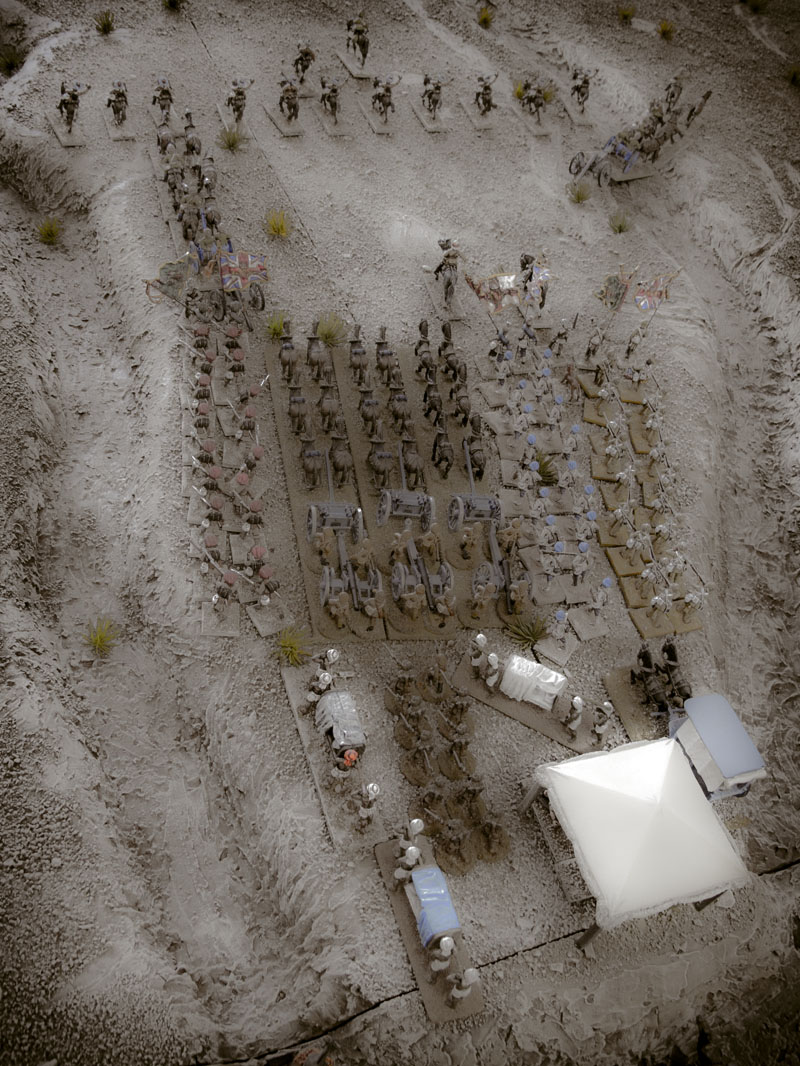
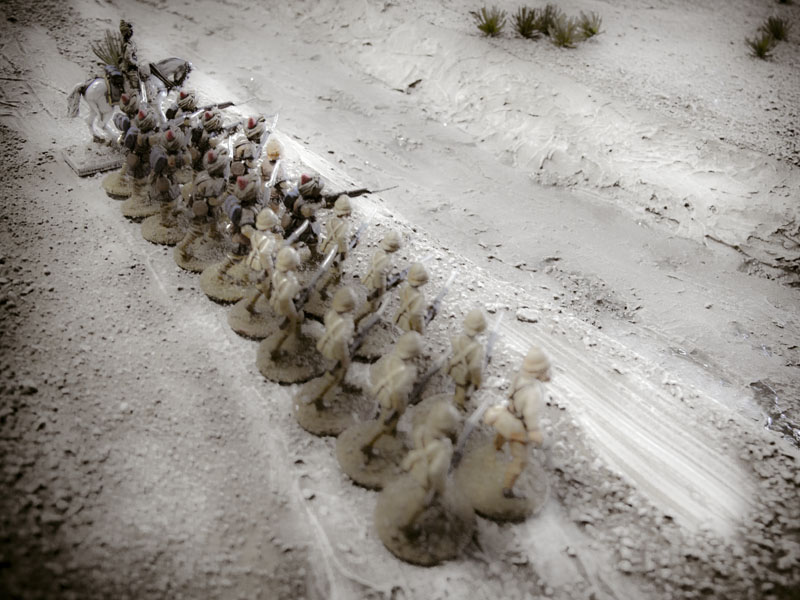
The game began with Lieutenant Hector Maclaine of the Royal Horse Artillery having already set up his 9pdr Field Gun (one gun w/4 crew, representing his 2-gun Section) within long range of the Northern-eastern edge of the table, where the Afghans would be entering. The remainder of the British brigade was laid down in their historical order of march, arrayed on the plain between the Western and center nullahs, with the Scinde Horse and 3rd Bombay Light Cavalry in open order skirmish line, one behind the other, another 2 RHA RML (Rifled Muzzle Loader) and 3 SB (Smoothbore) guns, all limbered up and advancing amidst march columns of 30th Bombay Native Infantry (Jacob's Rifles) on the left and 1st Bombay Grenadiers and 66th Regiment on the right.
The half-company of Bombay of Bombay Sappers & Miners (10 figs w/1 leader) followed the advance up the West Nullah, moving in March Column...
The Combined Baggage Guard (10 Brit. Inf. & 10 Ind. Inf. w/2 leaders each) took up position atop the South edge of Mundabad Ravine.
The Afghans brought in all 12 of their guns -- 3 Armstrong Rifled Breech Loaders and 9 lesser pieces -- literally as their "advance guard," allowance of which was a bit of an oversight by the collective brain of the players and Game Master in particular, but still probably didn't change all that much other than slightly speeding the time it took for them to get their artillery into action. As it was they were able to bring their guns -- particularly the Armstrongs, which outranged the best of the British guns by 12" -- to bear on the British immediately.
Afghan counter-battery fire proved painfully effective against the British guns set up on the plain, less so against the one RHA piece that dropped the trail of its limber in the center nullah, making it a CLASS IV TARGET. In fact, by TURN 6, three British guns -- 2 Royal Horse Artillery RMLs and 1 Smooth Bore -- had been put out of action by counter-battery fire alone.
The Afghans sent their TRIBAL CAVALRY (4 units, total of 50 figs) in on their left, down the East Nullah...
Afghans sent their REGULAR CAVALRY (3 units, total of 37 figs) in on their right, where it rode to the far Western edge of the table before turning South to face both units of British cavalry which had come up via the West Nullah and the flat plain...
Afghan REGULAR INFANTRY entered in two massed brigades, each comprised of four 20-fig units & 5 additional leaders.
The first Afghan Infantry brigade was comprised of 3 brown-uniformed Kabuli and 1 khaki-uniformed Kandahari regiments; the second Afghan Infantry Brigade was comprised of 2 HERATI, 1 HIGHLAND GUARD & 1 WALI'S MUTINEERS regiments.
The brown-coated Kabulis & Kandaharis entered in multiple successive ranks of OPEN ORDER, moving 3xD6 down the center of the Maiwand Plain, stretched in open order line between the West and Center Nullahs.
The mixed -- and mostly red-coated -- brigade was brought in behind the tribal cavalry on the Afghan left, stretching from the East to Center Nullahs.
For three turns the British continued to advance, trading artillery fire with the Afghans. It quickly became clear that the British would not do well in this exchange, being out-ranged and outnumbered.
THE BRITISH PLAN CHANGES
After advancing for 3 turns, the British began an orderly withdrawal towards the potentially strong defensive position of Mundabad Ravine and the villages of Mundabad and Khig to the South.
On TURN FOUR the British on their own LEFT FLANK turned the 66th Infantry and 30th BNI (Jacob's Rifles) around, marched them up out of the West Nullah -- where they were slowed down by moving through ROUGH TERRAIN and sent them marching in column atop the West edge of the table back towards Mundabad Ravine.
But in the center of the table, on the British RIGHT FLANK, the Bombay Grenadiers could not extricate themselves from the face of the Afghan advance so easily and so -- rather than fall back atop the plain where they would be easy targets for the powerful Afghan artillery -- they hunkered down in the Center Nullah and opened fire on the swarms of Tribal Cavalry approaching down the East Nullah. They were supported with fire from one of the RHA 9pdrs. and 2 of the 3 Smooth Bores. The combined efforts of the Grenadier rifles and the 3 British guns inflicted many casualties on the Tribal Cavalry --
ON TURN FIVE
3 remaining tribal cavalry units all CHARGED the Grenadiers in the Center Nullah.
At this point the Officer was WIA and the NCO was KIA, leaving the Grenadiers LEADERLESS in the face of looming hand-to-hand combat.
The only officer within reach of their lines was BRIGADIER GENERAL BURROWS himself.
General Burrows found himself in a heated debate with his escort and staff, all of whom argued he should NOT ride over to take command of the Grenadiers due to the terrible increase in personal risk and fear of the potential command & control disaster which might befall the entire brigade if he were to become a casualty. But the General disregarded these arguments, made for the Nullah and took command of the Grenadiers as they opened fire once more on the approaching ranks of Tribal Horsemen, supported once again by artillery fire from one RHA and 2 Smooth Bore guns...
These combined efforts wiped out nearly all that remained of the Tribal Cavalry and when it came time for the handful of survivors to roll to CLOSE INTO COMBAT with the close order line of Grenadiers in the Nullah below, they failed, turned tail and galloped away.
A cheer went up from the somewhat thinned-down (due to continued long range Afghan artillery fire at their covered position) ranks of the Grenadiers...
MEANWHILE ON THE OTHER SIDE OF THE BATTLEFIELD --
The Bombay Light Cav and Scinde Horse played a slightly odd game of cat & mouse with the 3 Afghan Regular Cavalry regts. opposing them. At first it appeared as if the British would launch an all-out 2 against 3 charge, sending both units against their 3 afghan opposite numbers -- but at the last moment the order was rescinded and the British Cavalry were kept in hand, the plan being for them to maintain a protective screen across the Left Flank of the British lines for several more turns in order to slow down the Afghan advance on that side of the field. But the Afghans took matters into their own hands and CHARGED the Scinde Horse -- but the Scinde Horse then managed to EVADE THE CHARGE and got away, and since the Afghan cavalry had charged they were unable to open fire that same turn.
TURN SIX
saw matters reach a critical point for the Bombay Grenadiers in the Center Nullah. At the very end of Turn 5 their OFFICER had recovered from his wounds and returned to ACTIVE DUTY, making it possible for Brigadier Burrows to head for Mundabad Ravine, where he needed to be in order to direct preparation of the defensive positions into which the rest of his brigade would soon hopefully by falling back.
A BLACK CARD was pulled and a horrible cry (to British ears) went up from the East Nullah, where masses of GHAZIS had been moving from the North-East corner of the table. 61 Ghazis -- 3 x 20-fig units plus their Mullah -- all CHARGED the thin khaki line of Bombay Grenadiers in the Center Nullah.
Now General Burrows faced a difficult decision. The Grenadiers were weakened but still a viable unit with 14 of their original 20 figures remaining in the fighting line. With enough support it could be possible for them to hold on, defeat the Ghazi onslaught and then retire along with the rest of the brigade back to the Ravine, using the Nullah to lessen the effect of Afghan artillery as they did so. The units that could provide this needed support were the 3 guns already set up in position to do so, the same guns which had helped preserve the Grenadiers in the face of dozens of Tribal horsemen.
But there was a difference. In one turn the situation had changed. Whereas before there was no serious threat of the British guns being overtaken by the enemy, now the general Afghan advance made such a threat very real and the number of Ghazis about to possibly close with the Grenadiers was far, far larger than the number of irregular cavalry who had threatened them last time. In his most difficult decision of the battle to this point, General Burrows chose to order all 3 guns to limber up and extricate themselves from the possibility of being overrun by the Ghazi charge. In doing so he preserved one of the strongest remaining assets on the British roster... but he also condemned the men of 1st Bombay Grenadiers to near certain death.
TO BE CONTINUED...


 These are all courtesy of the BLIND ARCHITECT -- aka: GAMER "X" (see the "About This Blog" page for a bit more info on him)